
The 2026 Executive Reality
Transformation is accelerating. The pressure to realize value is growing.
Organizations are managing more major transformations simultaneously, across AI, technology, operating models, and enterprise modernization. As initiatives multiply, so do the demands on leadership, resources, and organizational capacity.
3.5
The Pace of Change
Organizations are managing an average of 3.5 concurrent transformations, creating greater complexity in leadership decisions, resource allocation, and enterprise execution.
Source: KPMG, Transforming the Enterprise, June 2026.
70%
The Value-Realization Challenge
70% of surveyed change leaders reported that their most recent transformation fell short of its intended business value.
Source: Deloitte, The ROI of Change Management, October 2026.
The question facing executive sponsors
How do you know which transformation investments are building the conditions for lasting value—and which need leadership intervention before expected benefits are compromised?
The figures above come from separate studies with different samples and methodologies. They are not directly comparable.
The Executive Blind Spot
On track. On budget. Still at risk of missing the value.
A transformation can meet its milestones, deploy its technology, and satisfy its governance requirements without the organization being positioned to realize the intended benefits.
Executive dashboards and SteerCo reporting provide essential visibility into delivery progress, risks, and performance. But they may not reveal whether leadership ownership, organizational commitment, and adoption are developing alongside implementation.
The danger is discovering too late that the work progressed, but the organization wasn’t ready to make the change deliver.
This is the hidden variable NSP & Company set out to examine.
“The greatest risk in transformation is not failed execution. It is believing momentum exists when it does not.”
— Niki St. Pierre, Founder & CEO, NSP & Company
What We Examined
What separates transformation activity from sustained momentum?
NSP & Company’s 2025 Change Momentum Study examined 150 transformation assessments, collected during 2024–2025, with one initiative assessed per organization.
Rather than measuring project status or independently verified financial outcomes, the study examined the organizational conditions associated with whether change gains traction, takes hold, and can be sustained.
Each assessed initiative was classified into one of four Momentum Zones using NSP’s proprietary Change Momentum Index® (CMI®).
The Momentum Gap
47% had not yet reached the conditions associated with sustained momentum.
Nearly half of assessed initiatives were classified in Inertia or Acceleration.
Importantly, most of these initiatives were not stalled. The largest share was already moving—but the conditions associated with sustained organizational momentum had not fully developed.
Activity was visible. Sustained organizational traction was not yet established.
53% were in Momentum or High Velocity
2025 Change Momentum Zones
Source: NSP & Company, 2025 Change Momentum Study (N = 150). Percentages rounded. Zones describe point-in-time assessed conditions, not verified outcomes.
2025 Change Momentum Study
Three insights that deserve executive attention
01
47%
INERTIA + ACCELERATION
The Momentum Gap
Implementation progress can conceal organizational vulnerabilities. Nearly half of assessed initiatives had not yet developed the conditions associated with sustained momentum. Traditional delivery indicators alone may not reveal whether the organization is building the traction required to adopt and sustain change.
02
36%
ACCELERATION
The Acceleration Trap
The most easily missed stall is the one disguised as progress. Acceleration was the largest single Momentum Zone. Change was underway, but alignment, commitment, and execution conditions were not yet consistently reinforcing one another.
03
20%
HIGH VELOCITY
The Discipline Advantage
Stronger momentum is distinguished by discipline—not speed alone. Initiatives in High Velocity demonstrated stronger assessed conditions in measurement, leadership alignment, communication, and sustainability. Yet stakeholder buy-in remained a relative vulnerability, even among these stronger profiles—a reminder that momentum requires sustained organizational ownership, not just execution discipline.
The Buy-In Blind Spot Strong execution conditions do not guarantee consistent stakeholder ownership.
What the findings mean for leaders
Together, these findings suggest that the challenge facing many organizations is not a lack of transformation activity, but insufficient visibility into whether the conditions for sustained change are actually developing. That is the distinction between managing progress and managing momentum.
Executive Implications
Where leaders should start
Measure momentum, not just milestones
Review organizational clarity, leadership ownership, adoption, and execution alongside program delivery indicators.
Intervene before Acceleration plateaus
Identify the specific conditions limiting organizational traction before visible progress turns into prolonged under-adoption.
Build the discipline that sustains change
Strengthen measurement, alignment, stakeholder commitment, and reinforcement to support momentum appropriate to the initiative.
A New Management Lens
Beyond Milestones: The Conditions Behind Transformation Value
Organizations have invested heavily in planning, governance, and delivery discipline. These capabilities remain essential. But knowing whether initiatives are progressing is not the same as knowing whether the organization is positioned to realize their intended value.
The 2025 Change Momentum Study points to an additional management lens: Change Momentum™—the organizational traction that emerges when Clarity, Commitment, and Execution reinforce one another.
Managing Change Momentum™ complements existing project, program, and portfolio governance. It gives executive sponsors greater visibility into the conditions shaping whether change takes hold—and where leadership action may strengthen the path to sustained value.
From Insight to Action
The study reveals the challenge. The Change Momentum Index® helps leaders see where to act.
CMI® provides a focused assessment of the organizational conditions shaping momentum, identifying an initiative's Momentum Zone, what is strengthening or constraining traction, and where leadership attention is needed.
Designed to deliver actionable executive insight—not another layer of reporting—CMI® helps sponsors prioritize decisions and interventions. NSP's senior-led advisory then helps translate those findings into leadership alignment, actionable roadmaps, and coordinated execution.
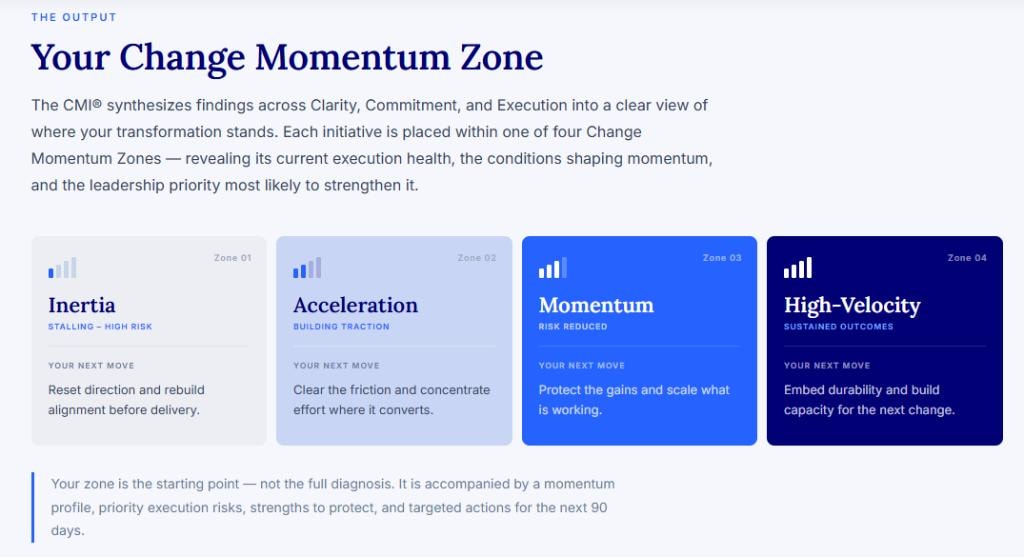
The CMI® classifies each initiative into one of four Momentum Zones—each with distinct conditions, risks, and recommended leadership actions.
The Conditions Behind Change Momentum™
The findings reinforce a central NSP perspective
Successful transformation requires more than implementation progress. It depends on the organizational conditions that enable change to be adopted, owned, and sustained.
Clarity
People understand the direction, why it matters, and what must change.
Commitment
Leaders and stakeholders actively own the change and reinforce its direction.
Execution
The organization has the capability and discipline to adopt, implement, and sustain new ways of working.
When one condition weakens, momentum becomes vulnerable—even when implementation remains on track.
About the Research
The 2025 Change Momentum Study comprises 150 assessments of transformation initiatives, one per organization, conducted during 2024–2025. Participating organizations ranged from mid-sized enterprises to Fortune 500 companies and included public-sector and nonprofit organizations.
Methodology note: NSP’s proprietary structured assessment examines conditions associated with Clarity, Commitment, and Execution and classifies each initiative into one of four Momentum Zones. The sample was not randomized or intended to be representative of all transformations. The classifications describe point-in-time conditions, not independently verified financial outcomes or causal effects.
About Niki St. Pierre
Niki St. Pierre is Founder & CEO of NSP & Company and a strategic advisor to enterprise leaders. Drawing on nearly three decades of experience advising Fortune 500 companies, government organizations, and complex enterprises, she created the Change Momentum Index® and led the 2025 Change Momentum Study. She is a 2026 Consulting Magazine Women Leaders in Consulting Honoree and author of the forthcoming Steady: Why Sustainable Momentum—Not Speed—Is the Leadership Edge of the AI Era. She designed the CMI® methodology and led the research behind this study.
Explore the Research
Know your zone. Know your next move.
Most transformation leaders are managing delivery. The CMI® briefing helps you see whether the organizational conditions for sustained momentum are actually in place—and where leadership attention is most needed.
Download the Executive Research Brief
Get the two-page overview of the study findings and executive implications.
Download the Executive Research BriefRequest the Full Research Report
Explore the complete 25-page study, including detailed Momentum Zone profiles, qualitative findings, research limitations, and executive applications.
Request the Full Research ReportDiscuss a Critical Transformation
Explore how CMI® and NSP’s senior-led advisory can help identify vulnerabilities, strengthen organizational traction, and support the realization of intended transformation value.
Request a 30-Minute Change Momentum BriefingMedia and speaking inquiries: Connect with Niki St. Pierre.